RetroHub games
Dé-Plus
Five dice of your own, and one with a mind of its own.
- Roll, keep, roll again: three rolls to build your hand.
 The pink die never rerolls: it counts, but it stays where it landed.
- Write your hand in a box on the sheet, and pass the turn. Twelve turns, twelve boxes.
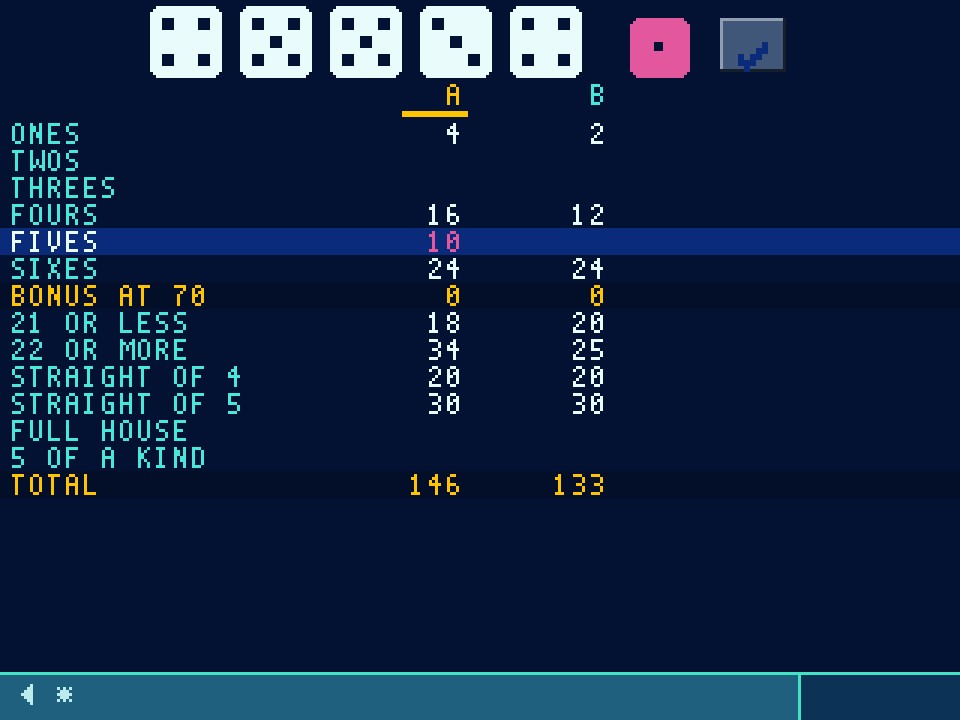
What is on the screen
The five white dice
Yours. These are the ones you keep or roll again.
The plus die
The sixth one, pink, smaller, set a little apart. It rolls on the turn's first roll, then it never moves. It gives the game its name.
The ✓ button
To the right of the dice. It lights up green when dice are marked: that is the reroll.
The sheet
One column per player, A to D. The letter underlined in gold is the one playing.
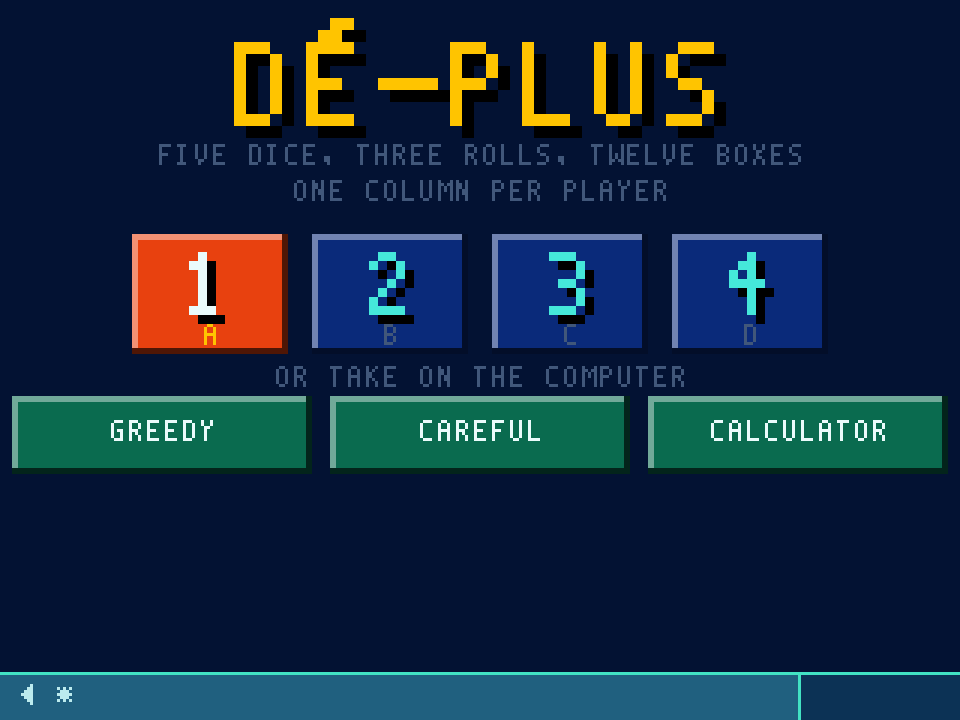
At launch: how many players?
The game first asks who is playing:
- 1 to 4: as many columns as players, passing the device around in turn. On your own, you play against your own sheet.
- Or the computer: it takes column B and plays when its turn comes. Three strengths, from simplest to sharpest: greedy, which takes whatever pays most right away; careful, which does not waste a valuable box on next to nothing; calculator, which also goes for straights and the bonus.
Tap your choice, or press the number. With the arrows, ▼ goes down to the computer's row and ▲ back up to the players.
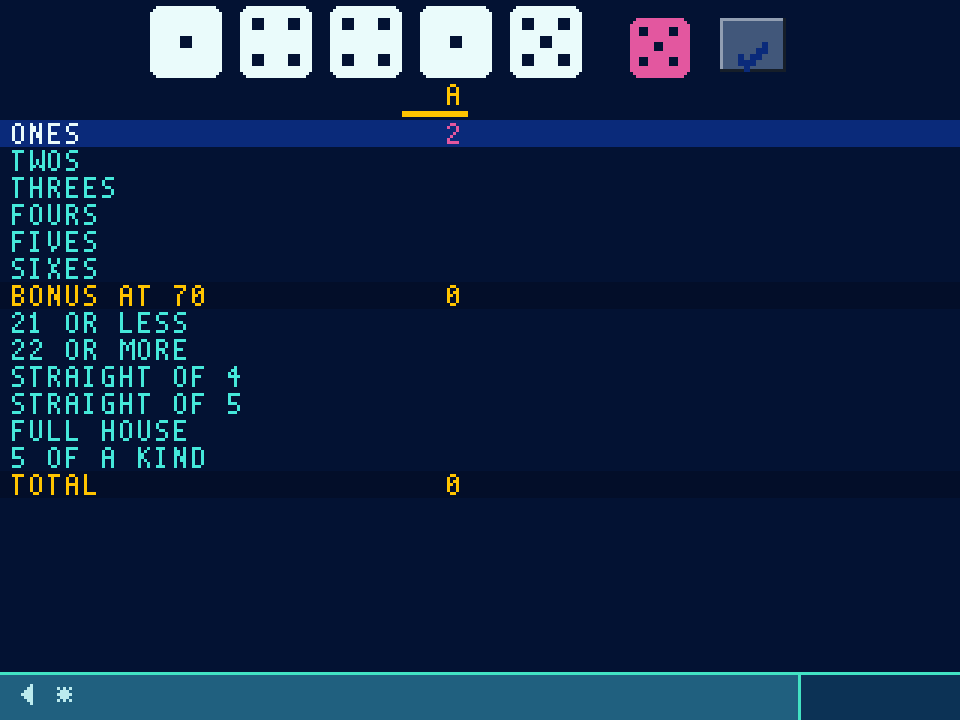
A turn
The first roll is made for you: the six dice roll and land one after another. While a die is rolling, nothing responds.
The pink die is already played. Whatever it shows, it is part of your hand until the end of the turn. Tapping it does nothing but play a refusal sound.
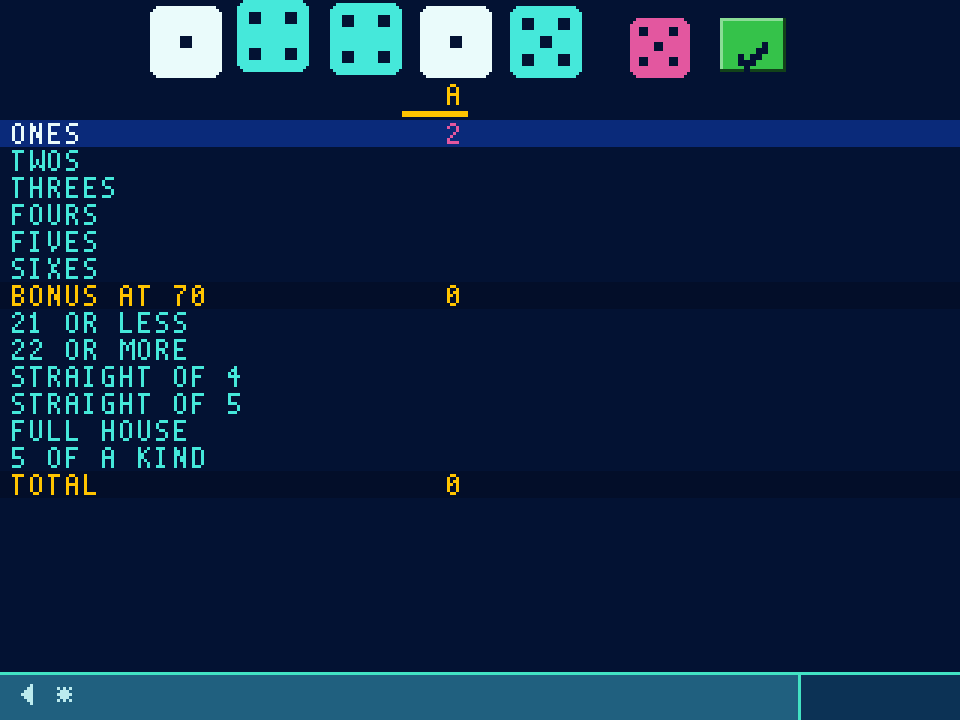
Mark the dice to roll again: tap them, or type their value. A marked die turns turquoise and starts to dance, to music. Tap it again to keep it.
Then ✓: the marked dice go again, the others stay. You get two rerolls per turn, three rolls in all. Nothing forces you to use them.
Choose a box: the highlighted line shows in pink what your hand would be worth there. Tap the box to write it in, or move the line there and press ✓.
You must write something every turn, even a zero in a box you would not fill otherwise. A filled box cannot be erased.
The turn then passes to the next column, which starts with a full roll.
The sheet
All six dice always count, the pink one included. Twelve boxes, in the sheet's order:
Ones to sixes
The sum of the dice showing that face. Three fours in the FOURS box: twelve.
Bonus at 70
Thirty-five more points when the first six boxes add up to seventy or more.
21 or less
The sum of the six dice, if it is no more than twenty-one. Above that, zero.
22 or more
The sum of the six dice, if it reaches twenty-two. Below that, zero.
Straight of 4
Four faces in a row, like 2-3-4-5: twenty points.
Straight of 5
Five faces in a row: thirty points.
Full house
Three dice of one face and two of another: twenty-five points. The sixth die can show anything.
5 of a kind
Five dice of the same face: thirty points. The pink die can be one of them.
The two bets split the table: six dice average twenty-one, exactly the line between them. A low hand goes in “21 or less”, a high one in “22 or more”, and the pink die often decides which of the two you have left.
The end
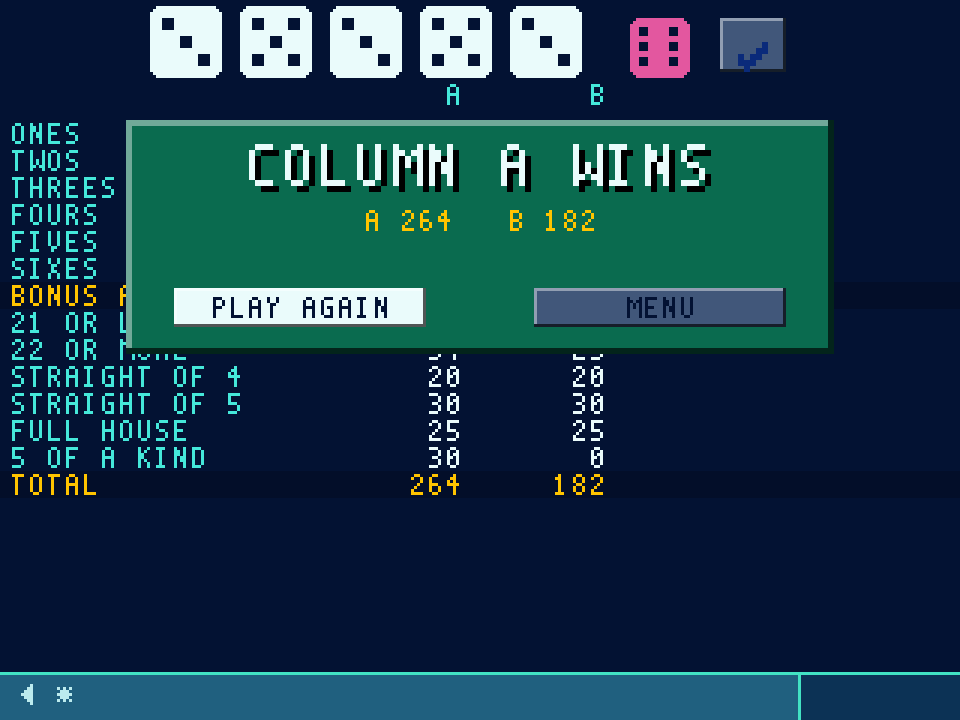
When every sheet is full, the game adds up: the first six boxes, the bonus, then the rest. The highest column wins; on a tie, nobody does.
Play again clears the sheets and starts over with the same players. Menu takes you back to the games menu. Dé-Plus keeps no score: the game is played for its own sake.
Controls
Phone and tablet
| tap a white die | mark it, or keep it |
| tap ✓ right of the dice | roll the marked dice again |
| tap a box in your column | write your hand in it |
| tap ◀ bottom left | leave the game |
Computer
| ↓ at the start | move to the computer's strengths |
| 1 to 6 | mark a die of that value |
| ← → | aim at a die, or the ✓ button |
| ↑ ↓ | choose a box |
| Space Enter | mark the aimed die, reroll, or write in |
| Esc * | leave the game |
Dice and boxes can also be clicked with the mouse.
Television
| ▼ at the start | move to the computer's strengths |
| ◀ ▶ | aim at a die, or the ✓ button |
| ▲ ▼ | choose a box |
| OK | mark the aimed die, reroll, or write in |
| Back | leave the game |
With nothing aimed at, OK rerolls if dice are marked, and writes in otherwise. The remote's number keys mark dice, where it has them.