The services
News, weather, horoscope, lottery results, finance, sports, and a video channel that plays on by itself inside the terminal: no list, no running time, and it does not send you anywhere else.
Réseau Inter-Système
In the early 1990s, the television set in the living room could do something other than television. You dialled a two-digit number and a mosaic of coloured tiles opened up: the news, the weather, the horoscope, games played by several people in front of the same screen.
RetroHub switches it back on. Everything is drawn pixel by pixel — no system font, no imported image. The screen is 320 by 240 dots, the palette holds sixteen shades, and the font was traced by hand.
News, weather, horoscope, lottery results, finance, sports, and a video channel that plays on by itself inside the terminal: no list, no running time, and it does not send you anywhere else.
Hangman, Tac-o-Tac, Croc-o-math, the Quizmaster, Yum, Problèmes, Backgammon, Pyramid, Tape-Brique, Zipper, Bowling, Bizz-Billes and Onyx. Letters, dice, cards, a board, games of skill and a pinball machine — and several are played by two people in front of the same screen, the way it was done then.
The same app serves the phone, the tablet, the computer and the television. On a remote, the number keys dial a service and the arrows move the cursor.
All of them are drawn by hand, at the same scale as the rest of the terminal. The pictures below are rendered from the application's own code: this is exactly what you will see.
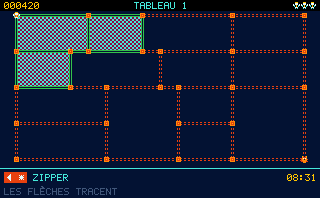
You trace, and everything you trace can come undone. Running along a side closes it; running it again opens it. A zone closed off on every side is yours for good and becomes safe ground. Meanwhile a creature undoes your work — and it senses you from further and further away as the boards go up.
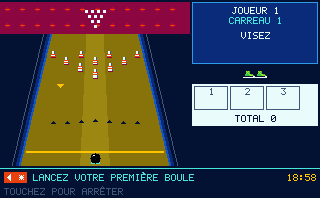
Ten pins, ten frames, and the scoring from the alley: a strike is paid on the next two balls, a spare on the next one. The ball is placed without hurry — the only step where time does not count — and then you choose the swing, and the spin.
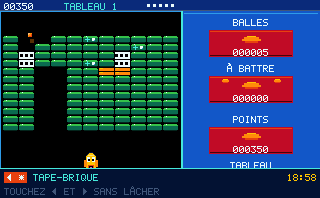
The paddle, the ball, a wall that crumbles. Every board has a drawing of its own, and some of them look back at you: a little man closes his eyes, a fish follows you.
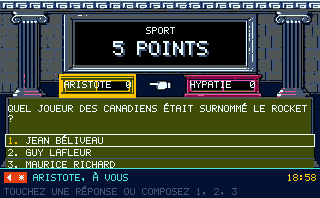
Two players, a Greek temple, and questions by the hundred. You choose the length of the joust before starting. A wheel sometimes decides what a question is worth, and a wrong answer can hand the point to your opponent.
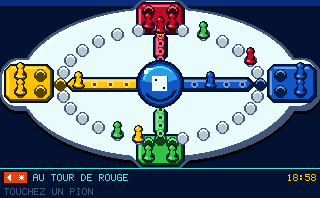
A run around a board with a die, under a dome, in four colours. You choose how many people play and how many computers. Landing on someone else's piece sends it home, and you need the exact count to come in.
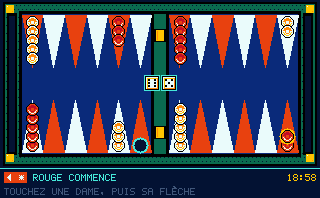
The board, the twenty-four points, the bar and bearing off. Your opponent does not play at random: it looks through the follow-ups before answering.
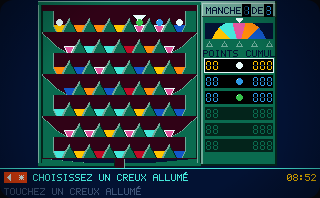
A wheel draws a colour, you take out a diamond of that colour, and whatever was resting on it falls — yours as well as everyone else's. Seven shelves to come down, and a marble never falls straight: it lands on a point and tips one way or the other. Everyone picks their marble colour at the start, and a game runs one, three or five rounds.
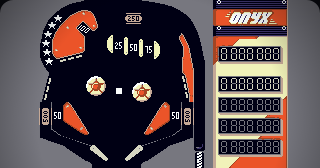
A pinball machine, traced dot by dot from its original cabinet. A plunger, two flippers, five balls. The bumpers push back, the slingshots catapult, the white bars drop one by one, and the plate at the top holds the ball for three seconds before firing it back very hard.
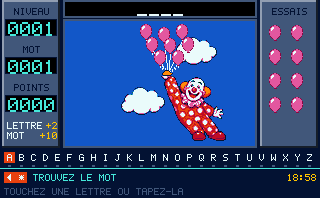
A word to guess, letter by letter, and a clown hanging from his balloons. Every mistake bursts one.
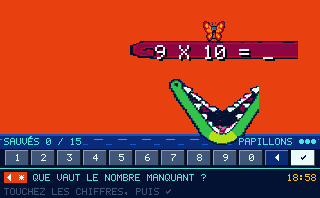
A sum with a hole in it, a butterfly, and a crocodile waiting underneath. Answer right and the butterfly climbs back up.
And also: Tac-o-Tac, Yum and Pyramid, against an opponent that thinks.
Several games are played by two people, each on their own device: you trade six letters, or you let yourself be matched with someone looking for the same game. No account is needed to play — you need one only to carry your own name rather than a nickname of the era, and to find your recent games again from one device to another.
Several games keep a high-score board, and first place is not number one: it is grand master. The board can be looked at without an account.
RetroHub imitates a terminal you found nowhere but plugged in behind the living-room television. That is where it goes back: on Google TV and Android TV, and on Apple TV. Same app, same store address — the television recognises it and lays it out its own way.
Everything is driven from the remote, without ever touching the screen. The hints along the bottom change by themselves to speak of arrows and the centre button rather than a finger, and the grid is walked cell by cell, the way it used to be.
And there are no ads at all on a television. Not a banner, not a video, not even the consent question: the app closes it as soon as it recognises a living-room screen. The games get the whole panel.
Together in front of the same screen, or each on their own device — a phone against a television is the same game.
Free, paid for by advertising. No account, no sign-up, no address to give.