RetroHub games
Bizz-Billes
The wheel lights, you remove, the marbles drop.
 The wheel picks a colour, and lights it all over the board.
 Remove a lit cup: whatever sat on it drops.
 The lower your marble goes, the more it scores.
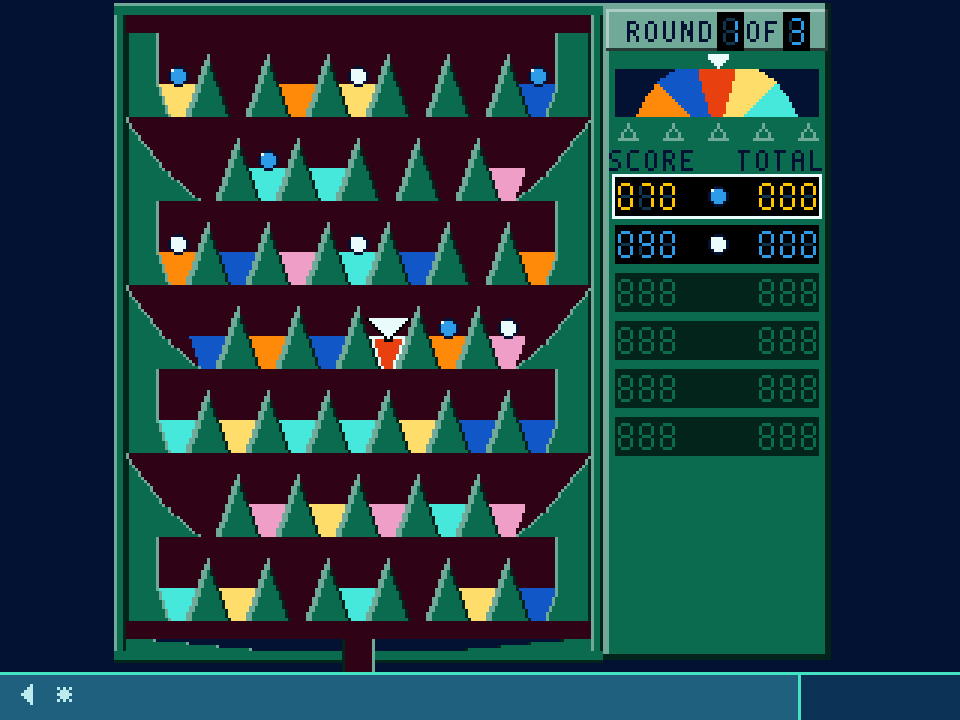
What is on the cabinet
Your marble
Everyone has their own colour. Marbles start on the top shelf, at random, two per cup at most.
The cup
The coloured slot between two pyramids. A marble rests in it; when it goes, the marble drops.

The arrow
It points at the cup you are about to remove, among the ones the wheel lit.
The wheel
It spins every turn and stops under the small triangle: that is the colour in play.
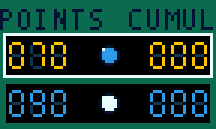
The displays
One per player: the points of the round, then the game total. Whoever is playing is framed in white.
A turn
The wheel spins and stops on a colour — always one still on the board. Every cup of that colour lights up, on all seven shelves.
You pick one, anywhere, and it disappears. If marbles sat on it, they drop. If it was empty, nothing moves — and sometimes that is exactly what you wanted.
Then the next player's turn comes, and the wheel spins again.
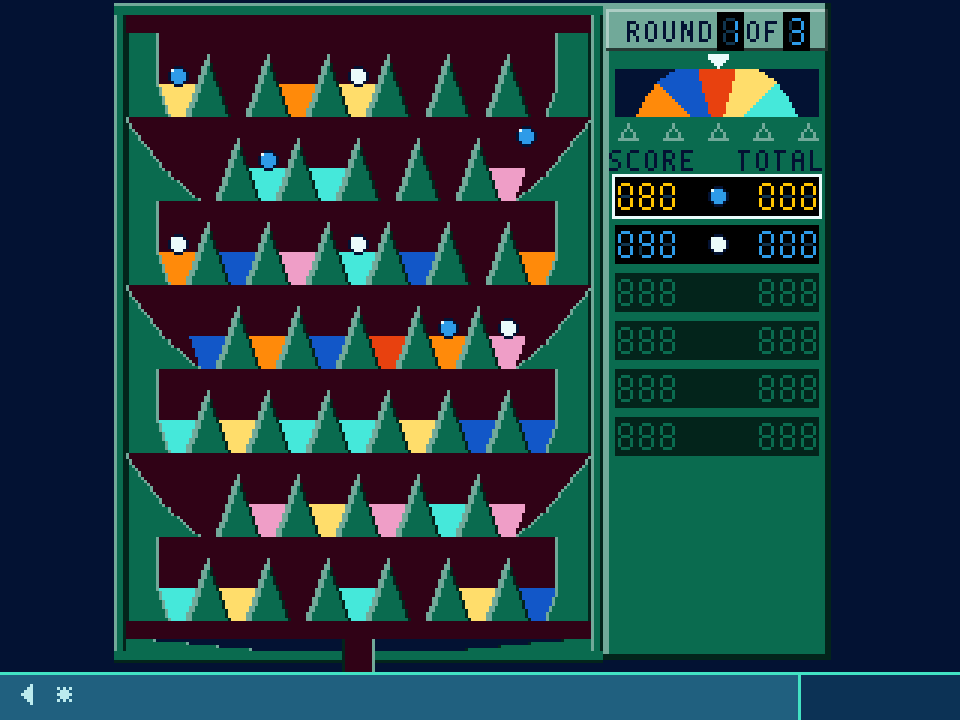
Where a marble lands
The shelves are offset by half a cup: under every cup sits the tip of a pyramid. A dropping marble lands on that tip, which holds nothing, and rolls left or right, at random.
If the cup it rolls into has already been removed, it keeps dropping, shelf after shelf, until it finds a cup — or reaches the hole at the bottom. A cup at the edge of a shelf has only one way out: inwards.
Two marbles can share a cup, three cannot. The third to arrive slides to the nearest free spot. And two marbles dropping together split up three times out of four.
Points
A marble scores the value of the shelf where it stops: the lower, the more it is worth. Points go to the marble, not to the player whose turn it is: making an opponent's marble drop scores for them.
Hence the two moves that drop nobody. Don't open a path: the most tempting lit cup is sometimes the one that would bring the other marble down. Burn the colour: a removed cup is gone for the whole round — spending it where it helps nobody takes it out of everyone else's game.
Rounds
The round ends as soon as a marble goes out the hole at the bottom — at the end of the current turn around the table, so nobody loses their turn. It also ends when no marble can go any lower.
The round winner is announced, the points join the total, and a fresh board is set up for the next one.
After the last round, the biggest total wins the game. On a tie, everyone in first place wins.
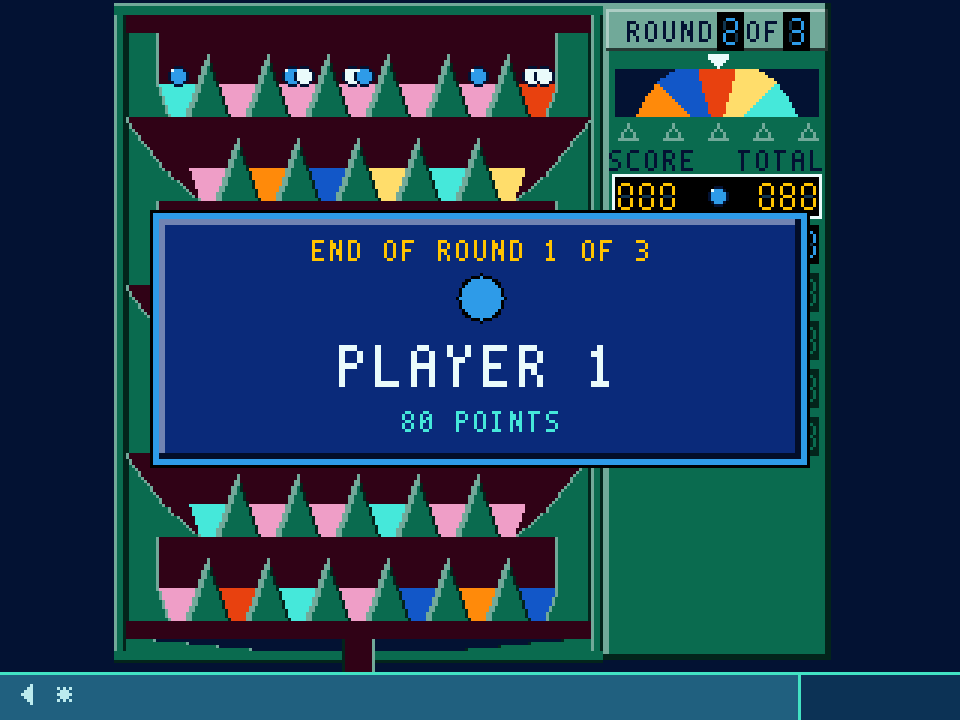
Before playing
How many players, one to six, around the same screen. On your own, you are not alone: the computer takes seat two, with a colour drawn at random.
How many rounds: one, three or five. Then everyone picks a colour, in turn; a taken colour stays in place, dimmed, with the name of whoever took it.
The fewer you are, the more marbles each:
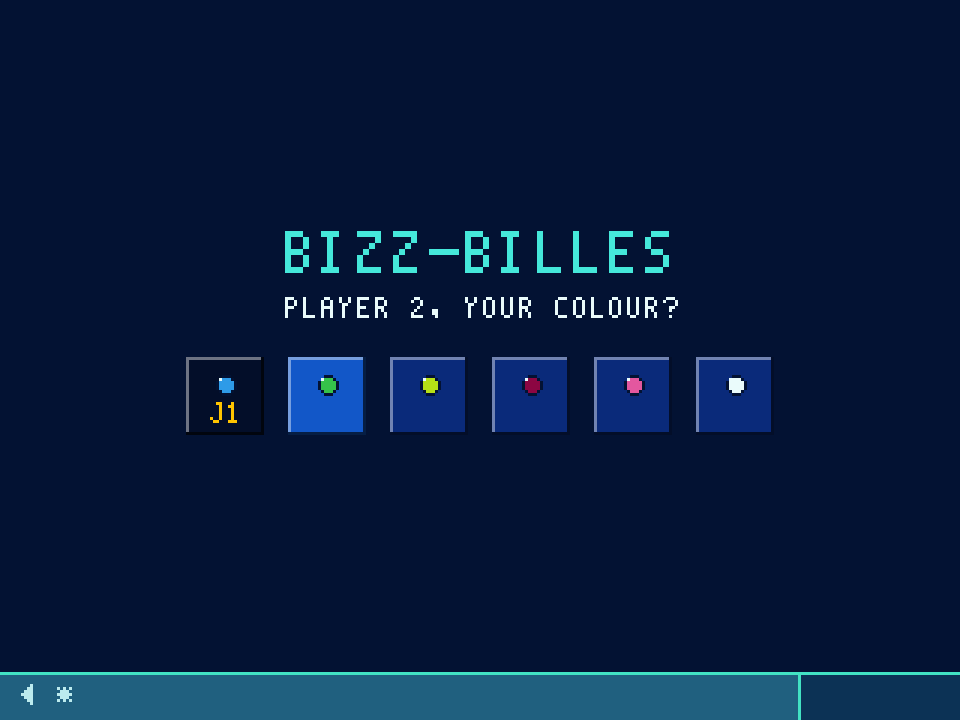
Online, each at home: invite friends with a code to read out to them, enter the one you are given, or let the game find you someone. Colours are handed out in order of arrival.
Controls
Phone and tablet
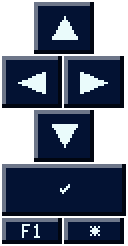
| touch a lit cup | remove it |
| ▲ ▼ ◀ ▶ | move the arrow from one lit cup to the next |
| ✓ | remove the cup pointed at |
| ✱ | go back a screen, or leave the game |
Computer
| ↑ ↓ ← → | move the arrow |
| Enter Space | remove the cup pointed at |
| Esc * | go back a screen, or leave the game |
Before playing, the number keys choose directly: 1 to 6 for players, 1 3 5 for rounds, 1 to 6 for the colour's place.
Television
| the arrows | move the arrow |
| OK | remove the cup pointed at |
| Back | go back a screen, or leave the game |
While picking colours, going back only undoes the last choice. Once the game is over, the check mark starts a new one, from the number of players.