RetroHub games
Tac-o-Tac
Take the most points, not the biggest number.
 You play along the row of the marker, and take the square.
 Teach plays down the column you just opened for him.
 The big number is often a gift… for him.
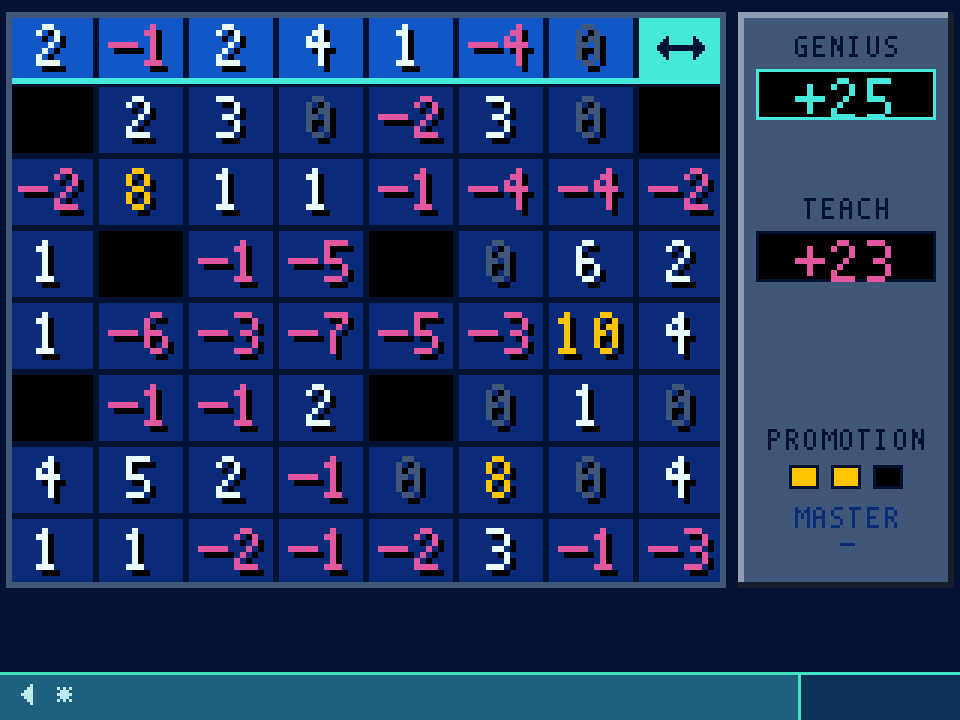
What is on the grid
Your square
Cyan, on the row framed in cyan. It is the marker: slide it to the square you want to take.
Teach's square
Pink, on the column framed in pink. The same marker, on his turn: it only moves up and down there.
The big numbers
In gold, from 8 to 15. There are only five on the grid: they are the ones that turn a game around.

The white numbers
From 1 to 7. Most of the game is played with them.

Zero
It is worth nothing. But it moves the marker, and so picks your opponent's line.

The pink numbers
Negative, down to −9: they come off your score. Sometimes they are the lesser evil.

The empty square
Already taken. The cursor skips over it, and nobody can stop there any more.
The rule
An eight-by-eight grid, and a marker set down at random — its starting square is worth nothing. You move the marker along its row: the square where it stops is yours, and it empties.
Then it is Teach's turn, down the column of that square. He takes his, and it is your turn again, on the row where he left you. And so on.
The game ends as soon as whoever must play has no free square left on their line. There is no passing: it is over, and the higher score wins.
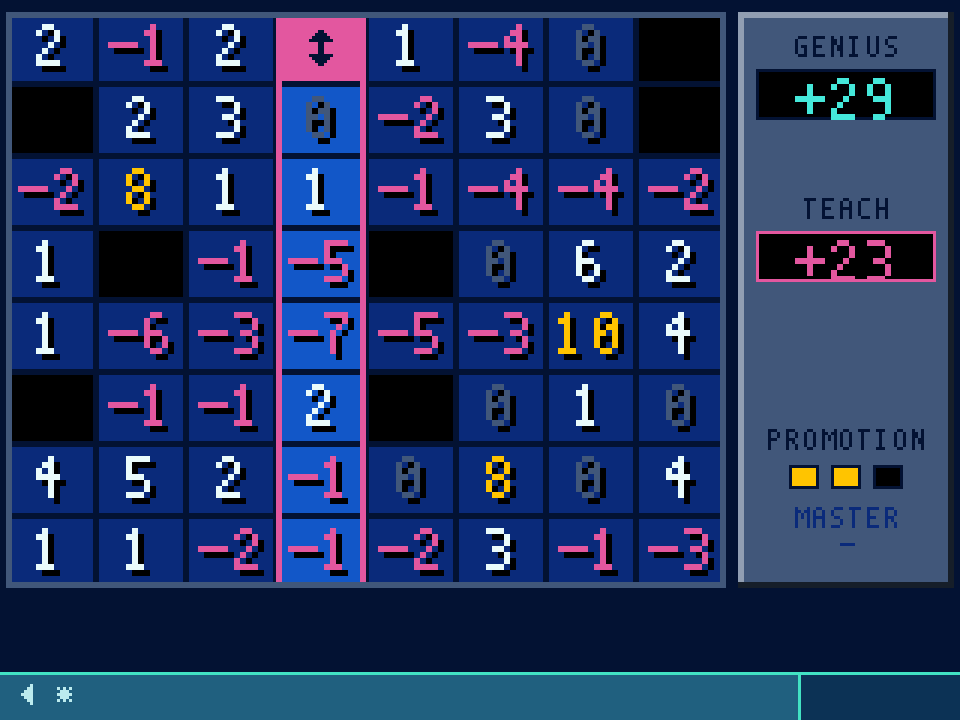
When you pick your square, you pick Teach's column. A 10 that opens a column where the 15 sits is a bad deal; a −1 that leaves him nothing but pink numbers can win the game.
The numbers are not drawn at random: they are the same sixty-four every game, shuffled. A grid is never lost before it starts — it all comes down to who takes what.
Teach, and his promotions

Three wins
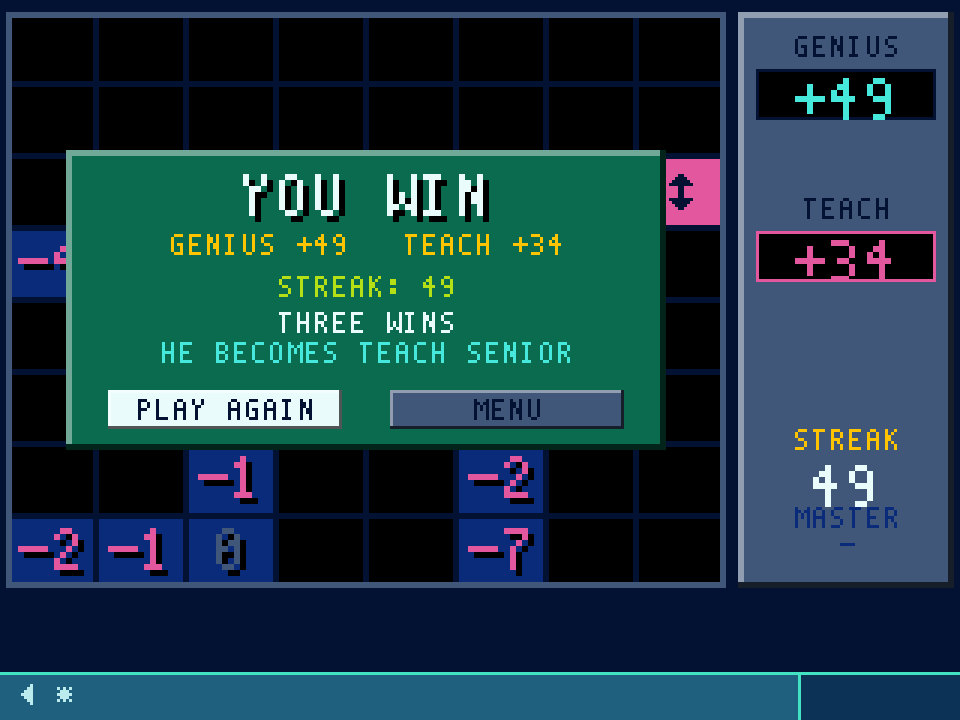
Every game you win lights a box on the gauge. On the third, Teach moves up a rank. A loss erases nothing.
The first Teach is greedy: he grabs the biggest number in his column, and opens whole rows for you without noticing. He is the one you learn the game with. Teach Senior holds his own; Teach Emeritus pulls ahead.
He takes his time, sometimes a long time — he scratches his head, rereads the whole column. He already has his answer: it is the pace of a terminal from back then, not a calculation.
Beating Teach Emeritus three times opens the elite club. There is no rank above him: from there on, you no longer climb, you score. The panel keeps the count of the points from the games you win during the session.
The rank, the gauge and the club start again from zero every time you enter the game.
The streak, and the masters' board
Against Teach, every win adds to your streak: the total of your points over the games won in a row. The panel shows it while it runs.
A loss or a draw ends it, and that is when it goes to the masters' board. Leaving the game ends it too: it is not lost.
The best score shows in the panel, under Master.
Who to play against
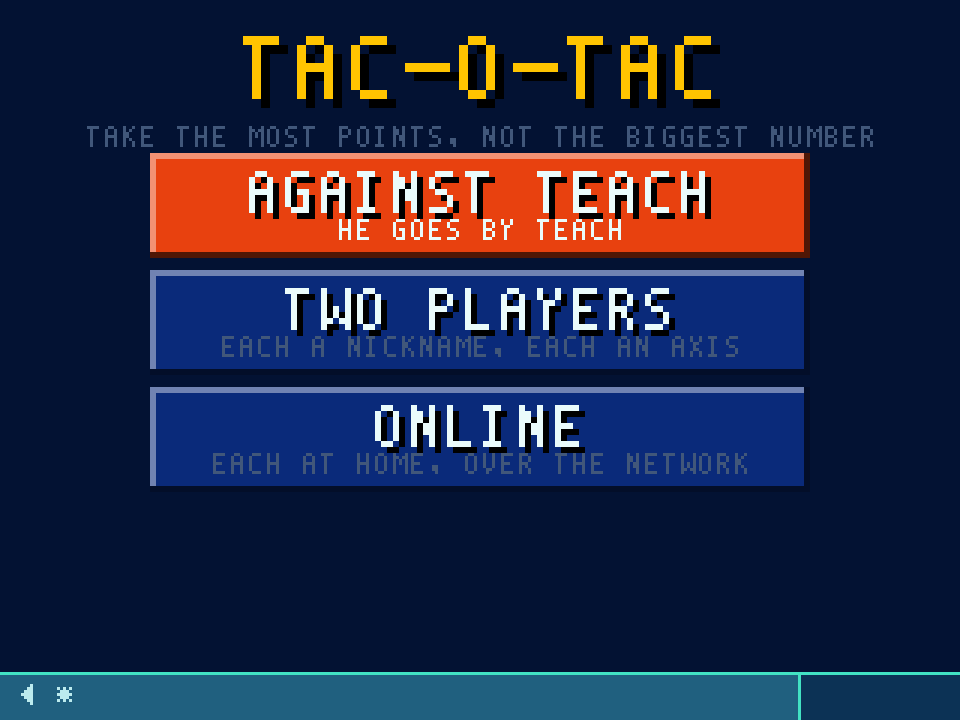
Against Teach is the game people come for, and the only one that counts on the board. Teach will call you by the nickname you choose.
Two players, on the same device: each with a nickname, each with an axis. The first plays along the row, the second down the column, and the panel counts the rounds.
Online, each at home: invite a friend with a code to read out to them, enter the one they give you, or let the game find you someone.
A challenge sent to a friend is always played against Teach.
Controls
Phone and tablet

| touch a number | take it, if it is on your line |
| ▲ ▼ ◀ ▶ | slide along your line |
| ✓ | take the square |
| ✱ | leave the game |
Computer
| ↑ ↓ ← → | slide along your line |
| Enter Space | take the square |
| Esc * | leave the game |
All four arrows work on a row as on a column: only one line is playable at a time.
Television
| the arrows | slide along your line |
| OK | take the square |
| Back | leave the game |
Once the game is over, Play again deals a new grid and Menu returns to the choice of opponent.